Be yourself; Everyone else is already taken.
— Oscar Wilde.
This is the first post on my new blog. I’m just getting this new blog going, so stay tuned for more. Subscribe below to get notified when I post new updates.
Be yourself; Everyone else is already taken.
— Oscar Wilde.
This is the first post on my new blog. I’m just getting this new blog going, so stay tuned for more. Subscribe below to get notified when I post new updates.
The Liverpool Street station was one of the largest and busiest stations that I had seen on our trip so far. It had numerous places to eat and shop amongst all the modes of transportation that it provided. This station is home to the original location of Bedlam hospital. I tried to look for evidence or any traces of this hospital in the station’s architecture. I’m not sure which parts are still part of the original hospital, but from personal observation I believe the brick walls with the arched detailing and windows looks reminiscent of what could be an old hospital.
Besides that, the high glass ceilings did not give the impression that this station used to be a hospital. There was a plaque outside the building that stated to the public that it was the first site of the hospital. If we had not asked a guard where we could find it, I do not think we would have found it on our own. It was outside on the side of the building and it was not very obvious on the wall. It almost gave the impression that the architects did not really want the people to know that this building used to be a mental hospital. The plaque was less of a memorial and more of a lowkey sign of what the building used to be.
A memorial that I did see inside was one that remembered the children who used the Liverpool street station as a means of escaping Nazi persecution. It is an iron looking memorial with two children and their suitcases waiting for their train. The history and experiences that have happened in this station is so much and so heavy. The memorial for the children stood out to me amongst the modern cafes and shops that now align the station. It became obvious that the children have a memorial and not those who died at this hospital maybe because of the stigma behind mental illness. According to the Ackroyd reading, Bedlam was the only mental hospital in all of the UK at the time. The hospital “represented an intensification of the worst aspects of London life.” (Ackroyd 604) It seems that mental illness was something that people did not want to acknowledge or have to face.
I saw this to be true again at the Imperial War Museum. The Imperial War Museum holds another historical piece of the Bedlam hospital. There is another plaque that explains its history outside the gates of the museum. This museum was located in a beautiful park and was nicely laid out and detailed for a free museum! The first floor had many airplanes and tanks that replicated those that were used in the war. Another floor explained the history and importance of music during the time of the war. This was my favorite exhibit because of it’s interactions with the guests. We sat down at one of the benches in a dim room with few colorful lights and listened with headphones to some very inspiring music from the war. There was also a fun screen that would put up questions such as “if you knew a concert would be dangerous would you still go” and you would have to press agree or disagree. Afterward it would tell you how many other visitors agreed with you. I think the purpose of this exhibit was to show the power and influence of music to the culture of the people during a hard time for everybody. It also shows how much people needed music for the strength of their community. The Holocaust exhibit was not open when we went but I would like to go back during the times it is open.
According to the Richardson article, the dome on top of the museum is original from the Bedlam hospital. Keeping some of the original architecture is memoriam in itself, but I got the same feeling that it’s history as a hospital was not something that the architects wanted to be a main feature. It would have been interesting for this museum to have maybe a small section about the buildings history when it was Bedlam. Visiting Liverpool Street Station and the Imperial War Museum were surprising in that I was expecting more of an obvious representation of the past of Bedlam. They both had small plaques explaining what was there before, but no memorial in what happened in those sites. If I had not gone there knowing the history of these buildings, I would have never guessed their historical importance. To me this represents the stigma and underlying feelings about mental illness in the past and even today.
The Festival Hall was almost something I missed because of it’s plain exterior amongst an area of exciting things to do and see. It has a dry looking appearance because it is only a grey structure with the title of the building on it.
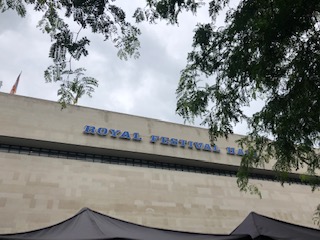
However, the building inside is much more exciting than it’s dry outside. I did not know what to make of all the things going on inside the building or what it’s purpose was. Then I realized that that is exactly what it is for-to be a multipurpose establishment. Adrian Forty’s reading mentions how we can not tell what this building’s historical significance is by looking at the building itself or it’s architecture. We should look at the experiences that have occurred in the building and how they relate to what goes on now. It was lovely to see families eating dinner in one part of the building and to look down and see people dancing the tango in another. This building also hosts several events and concerts. The purposes of the building keep most of what originally happened here-concerts and dancing. The advertisements for their events line the building walls. However, the interior the building has a very modern feel. There was neon lights amongst colorful chairs and tables.
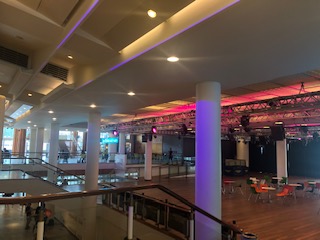
This building had multiple floors that can be used for any purpose or event. I got the same feeling when I visited the Barbican Center-that each floor was so different from the next. The Barbican Center was not what I expected it to be nor could I tell from the outside what it would be either. Again, the exterior is very plain and average but the inside had some of the most interesting things that I have never seen. The modern technology on the first level was very fascinating and fun to experience. There were two large screens when we walked in that mimicked people’s movements with virtual designs. If someone moved their arms around, then the design on the screen would move with the person. I was surprised when that was the first thing I saw when I entered the building because my impression from the building’s exterior did not match with what was inside. The exterior of the building led me to think it would be offices or maybe apartments inside, not something completely amazing that I had never seen before. Further along the first floor there was a robot bartender!

As I walked up the stairs to the next floor I expected the whole building to be exhibits of artificial intelligence or modern technology, but every floor had a different purpose or theme. One floor was a garden with ponds and tall trees indoors.
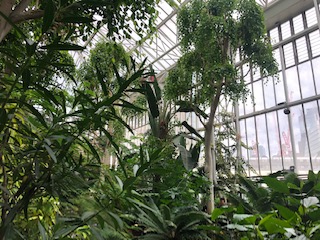
Another floor was an art gallery. I was in disbelief to know that this building was social housing. According to Tsubaki, “the gentrification of nearby inner city areas meant that the Barbican no longer appeared so different from its neighbors.” (541) This was evident in my first impression of the building because I could not tell what was special about this building from the outside or that it was even going to be a multipurpose exhibition of exciting things to see. It definitely blends in with the rest of the nicer buildings in the area and does not look like it would serve as a place for social housing. The Royal Festival Hall and the Barbican Center exemplify brutalist architecture in a modern environment. They both appear to blend in with their bland, plain exteriors but have amazing sights and experiences on the inside. However, one kept it’s original purpose of being a multipurpose building for music and events, while the other has completely changed due to it’s environment. It is interesting to look at these kinds of buildings because I did not know what to expect from outside. It was always a nice surprise to see that the inside was more entertaining than the building’s outside!
The Karls-Mark Hof brought nuance to social housing by bringing a strong sense of community to the people living in Vienna. As I walked into the housing areas, I did not understand what was so special about them architecturally. They look very average compared to the other sites that we had seen previously, but once I gained knowledge about their history I found this place to be very fascinating. The way political views are implemented into the architecture makes a strong statement about the historical importance of the building. It shows me that the Socialists wanted their work to tell a story and let those in the future know about the significance of the buildings. For example, I thought the four statues along the entrance of the Karl-Marx Hof were very interesting because of how symbolic they were. They represent the struggles and accomplishments of that time era and the housing such as the high interest in sports, the growing number of kindergartens and libraries, and breaking free from communism. The Karl-Marx Hof was much larger than I expected and I also did not expect people to still be living there due to the constant tours that are being given. I loved the sense of unity I felt while walking around the premises and seeing the communal gardens and kindergartens that are provided. It became obvious that during this time of need for the people of Vienna, community was necessary not just for physical benefits but also for emotional support and encouragement.

The Amalienbad public swimming pool is another example of the strong sense of community that the Viennese prioritized during this time. It does not look like it would be a pool from the outside.

However, the statues that are outside the building must represent something about swimming because I think they are people taking their clothes off. It was an interesting experience going inside this building because of the language barrier between us and the woman at the ticket counter. She didn’t speak a word of English and seemed irritated at us for not knowing any German. We were able to walk up to the windows to see inside the pool area. I thought it would be more like a relaxing and socializing kind of pool, but the people in there were doing laps and swimming more for exercise. I think this served a great purpose for those in the past because it was a place for the community to share the new importance of physical health together and encourage others to better themselves. I wonder if in the past it was more of a social pool where people relaxed and converse or if it was just like how it is today where it is focused on physically swimming. Lastly, the Reumannhof is another communal living building that to me was reminiscent of the Karls-Marx Hof. This building looks unique from the outside because of the windows that face out from each other that add an interesting texture to the apartment building.

Just like the Karls-Marx Hof, there is a kindergarten there that is represented by a little statue of children playing. The kindergarten is still in use and we saw the children inside the classroom.

Next to the kindergarten is a peaceful area that looks somewhat like a park or just a nice place to relax and enjoy the outside grounds. It Is down a set of stairs where the air is cooler and contains many benches for the residents to sit and converse. This gives the residents a chance to hang out with each other and again, provides another example of the importance of community for the people of Vienna.
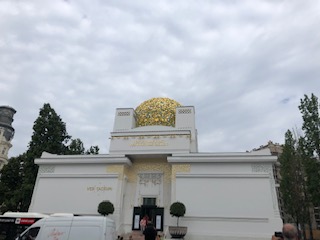
The buildings that I have seen and experienced this week were built during the period of the Secession. These buildings stray away from the grand, striking decorations and ornamentation that the previous architectural movement in Vienna represented. The buildings created during the Secession were more focused on their purpose and structure, rather than their appearance and decorations. The Secession Building by Joseph Olbrich is a perfect example of the architecture during this time.
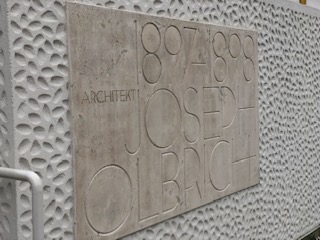
I spotted this building from far away because it’s beautiful gold dome is difficult to miss. This gold dome has floral ornamentation and looks absolutely stunning against the white paint on the building. White and gold are the only two colors that make up this building.
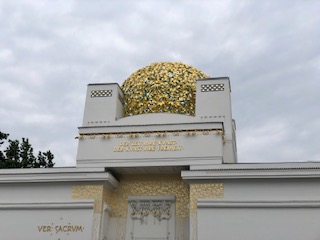
The details of the decor are very intricate, but these decorations mostly only exist on the front of the building. The rest of the building keeps it’s plain white color which I think looks very sleek and simple. The floral decorations are very modern looking and to me resembled the start of a new age of architecture. Although the beautiful gold dome has a striking appearance even from far away, it is the main focus of the building and does not overwhelm the overall appearance of the structure.
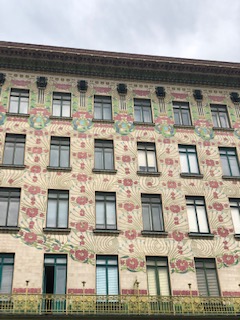
The coloring on the Majolikahaus caught my eye after exiting the market. The beautiful flowers that are engraved on the building are a simple decoration that adds life and color without being overly dramatic and distracting.
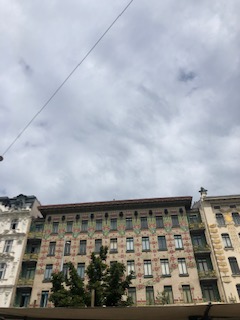
The building keeps a uniform square shape with square windows that do not have anything protruding from the building. I really enjoyed visiting this building because of it’s subtle beauty and color that do not distract people from it’s purpose of being an apartment building.
The Raiffeisenbank is another great example of the simplicity of the architecture during this movement. It is interesting because it is right next to the Hofburg, which is a magnificent and impressive looking palace. However, this bank is almost easy to look past because of how plain it is compared to the Hofburg.
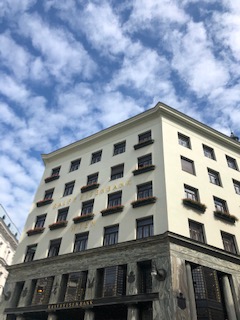
It has a simple square façade. It’s only decoration are boxes of flowers under some of the windows. It is obvious that this building’s priority is to serve as a bank, and not as a beautiful appearance for the public eye. It was a little unexpected to see that inside it is very sophisticated and dark compared to it’s brighter façade. The inside is all mahogany along with gold details and emerald carpet.
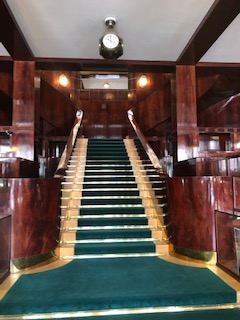
To me, the nicer interior shows that the purpose of the bank and making the customers feel comfortable while inside is more important than what is going on outside the building. These buildings were strikingly different than those that I saw that were built from the previous architectural movement. Purpose has become a top priority for these architects while still maintaining an excellent appearance.
Vienna’s atmosphere is crisp, clean and sophisticated. The buildings and structures have much historic meaning and are very aged, however they keep their pristine look and feeling. The Karlskirche building has two distinct plague columns in the front.
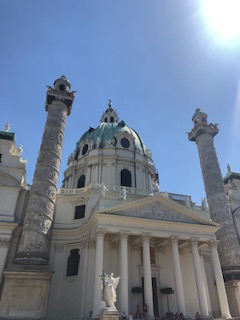
From far away you cannot see, but if you look closer you can see the columns are engraved with hundreds of people spiraling up the column. These somber people are victims of the plague and add a powerful detail to what otherwise looks like another beautiful Viennese building.
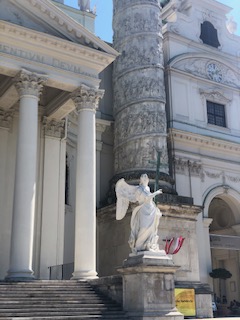
The statues of the people atop the building look welcoming and peaceful. Some of them are angels, but all of them have open arms, relating to the baroque style of the church. There is a large pool of water in front of the church where locals dipped their feet in and relaxed while reading a book or chatting with friends. The Karlskirche seemed to be a place for the people of Vienna to spend time together and hang out, whether that be by the water or right on the front steps. Considering how people hang around this building, it is well respected and cared for.
The University of Vienna was not what I expected it to look like. It is quite amazing and resembles more of a museum than a typical university that I am used to. The university has large, welcoming arches. Some of the windows are surrounded by these arches or have simple square frames.
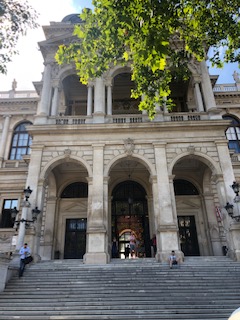
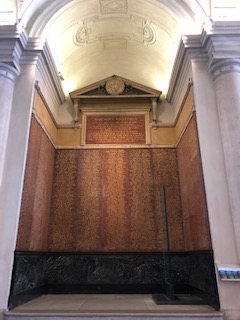
Again, I got the impression of the historical importance of this building but also noticed how well maintained it was. Just like most universities, the University of Vienna has obvious pride in their notable alumni, one of whom is Sigmund Freud. They have a beautiful wall of names of alma maters and pictures of their most famous alumni.
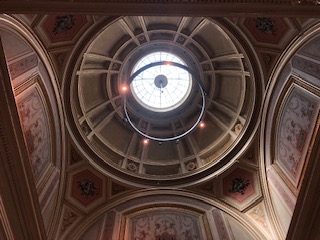
The domed ceilings have intricate artworks that surround the circular glass for the sun to shine through. The natural light makes the room look warm and highlights the details of the ceiling nicely. The architecture and presentation of the university looks to be a priority of the institution. The main hallways and stairwells are open and wide. The actual classrooms are much smaller and not as beautiful as the rest of the school. They are very bare and condensed compared to the openness of the main walkways. The university ensures that it looks grand and sophisticated to the public eye.
Viennese buildings prioritize their façade and appearance to the crowds. The Karlskirche building is a place of worhsip, but was mostly built to symbolize the end of the plague and is a place of union for the Viennese people. The university is obviously and educational institution, however it also showcases it’s historical significance and beauty to the public eye. These great architectural works have shown me how passionate the people of Vienna are about the appearance of where they live and how they take care of their home.
This is an example post, originally published as part of Blogging University. Enroll in one of our ten programs, and start your blog right.
You’re going to publish a post today. Don’t worry about how your blog looks. Don’t worry if you haven’t given it a name yet, or you’re feeling overwhelmed. Just click the “New Post” button, and tell us why you’re here.
Why do this?
The post can be short or long, a personal intro to your life or a bloggy mission statement, a manifesto for the future or a simple outline of your the types of things you hope to publish.
To help you get started, here are a few questions:
You’re not locked into any of this; one of the wonderful things about blogs is how they constantly evolve as we learn, grow, and interact with one another — but it’s good to know where and why you started, and articulating your goals may just give you a few other post ideas.
Can’t think how to get started? Just write the first thing that pops into your head. Anne Lamott, author of a book on writing we love, says that you need to give yourself permission to write a “crappy first draft”. Anne makes a great point — just start writing, and worry about editing it later.
When you’re ready to publish, give your post three to five tags that describe your blog’s focus — writing, photography, fiction, parenting, food, cars, movies, sports, whatever. These tags will help others who care about your topics find you in the Reader. Make sure one of the tags is “zerotohero,” so other new bloggers can find you, too.

 Gabby's Blog